Brain Mechanisms of Concept Learning

Zeithamova, Dagmar, Michael L. Mack, Kurt Braunlich, Tyler Davis, Carol A. Seger, Marlieke TR Van Kesteren, and Andreas Wutz. “Brain mechanisms of concept learning.” Journal of Neuroscience 39, no. 42 (2019): 8259-8266.
Definitions
- Categories: Distinct collections (classes) of concrete or abstract instances that are considered equivalent by the cognitive system.
- Concepts: Mental representations of categories (Murphy, Gregory. The big book of concepts. MIT press, 2004.).
- Cognitive Categorization: A type of cognition that involves conceptual differentiation between characteristics of conscious experience, e.g., objects, events, or ideas. It involves the abstraction and differentiation of aspects of experience by sorting and distinguishing between groupings, through classification or typification on the basis of traits, features, similarities or other criteria that are universal to the group. It is grounded in the features that distinguish the category’s members from non-members.
- Concept Learning: The ability to extract commonalities and highlight distinctions across a set of related experiences to build organized knowledge.
- Medial Temporal Lobes (MTL, 内侧颞叶): 负责记忆的形成与整合,在学习、记忆和空间导航等方面扮演核心角色。它不是一个单一的结构,而是包括了多个与记忆相关的脑区:
- 海马体 (Hippocampus): 将短期记忆转化为长期记忆,在空间记忆和导航中起作用。
- 海马旁回 (Parahippocampal Gyrus): 场景识别,空间背景
- 杏仁核 (Amygdala): 处理与情绪相关的记忆
- 内嗅皮层 (Entrohinal Cortex): 大脑新皮层和海马体之间的“信息通道”
- 齿状回 (Dentate Gyrus),海马下区 (Subiculum): 记忆的编码和回忆
- Prefrontal Cortex (前额叶皮层): 人类高级认知功能的核心区域,负责计划、推理、决策、注意力控制、社会行为和自我调节。包含几个亚区:
- 背外侧前额叶皮层 (Dorsolateral PFC):
- 执行功能(计划、推理、任务切换、抑制冲动)
- 工作记忆(working memory,暂时保存并操作信息)
- 认知控制
- 腹内侧前额叶皮层 (Ventromedial PFC, vmPFC):
- 情绪调节,理解他人意图(Theory of Mind),自控能力
- 社会行为调节(道德判断)
- 风险评估
- 哐额皮层 (Orbitofrontal Cortex):
- 奖惩学习
- 冲动控制
- 情绪相关决策
- 前扣带皮层 (Anterior Cingulate Cortex):
- 冲突监控
- 注意力控制(选择性注意,持续注意)
- 情绪调节
- 背外侧前额叶皮层 (Dorsolateral PFC):
- Rostrolateral Prefrontal Cortex (前外侧前额叶皮层): 约对应于Brodmann area 10的背外侧部分,是人脑前额叶皮层中最靠前、最外侧的一个区域,位于额极(frontal pole)附近。这个区域在人类中高度发达,是人类认知能力进化的关键区域之一。功能:
- 抽象思维与推理(Relational Integration / Abstract Reasoning)
- 处理多个关系之间的组合(如A比B大,B比C大 → A比C大)
- 在复杂任务中整合不同层次的信息
- 元认知(Metacognition)
- 对自己思维过程的反思和监控,例如“我知道我知道”或“我不确定”
- 前瞻性记忆和计划(Prospective Memory & Planning)
- 设定未来目标、在多个任务之间进行切换与控制
- 跨情境一般化(Contextual Transfer)
- 在新情境中类比、应用以前学到的规则或策略
Questions
- What are the roles of the hippocampus, ventromedial prefrontal, lateral prefrontal, and lateral parietal cortices in concept learning?
- How their engagement is modulated by the coherence of experiences and the current learning goals?
The dynamic formation of concept representations during category learning
- Background: Human concept learning is rapid, flexible and generalizable (i.e. adapt newly learned knowledge to novel situations or changing goals with little effort).
- RQ: What are the neural mechanisms that support such rapid, flexible and generalizable concept learning?
- Mack et al., 2016
- Goal: Identification of the neural machinery of the formation of new concepts in hippocampal activation patterns.
- Model: SUSTAIN, a computational model that accounts well for behavorial responses during category learning. Fitting this model to each participant’s learning behavior provides predictions about how category items were represented in a multidimensional space, and thus how similar they may be perceived by the participant.
- Intuition: The more similar two items are represented by the model, the more similar should be their neural activation patterns.
- Result: A region in anterior hippocampus shows neural representations that are consistent with the model-based similarity matrices.
- Conclusion: As learning goal changes, hippocampal representations reorganized to reflect the diagnostic information important for the current task.
- van Kesteren et al., 2012; Zeithamova et al., 2012; Schlichting and Preston, 2016:
- The hippocampus does not act alone in building new concepts. Instead, there is a functional alliance between hippocampus and medial PFC when encoding new information that overlaps with prior experiences.
- Mack el al., 2016
- Anterior hippocampus demonstrated a strong functional coupling with ventromedial PFC (vmPFC) during early learning when concept updating is most potent.
- The vmPFC may play an important role itself in guiding attentional tuning during new concept learning.
- Mack el al., 2019
- Neural representations in vmPFC systematically track the efficient mapping of stimuli to categories in a manner consistent with highlighting relevant features and down-weighting irrelevant ones.
Specific and generalized representations supporting categorization
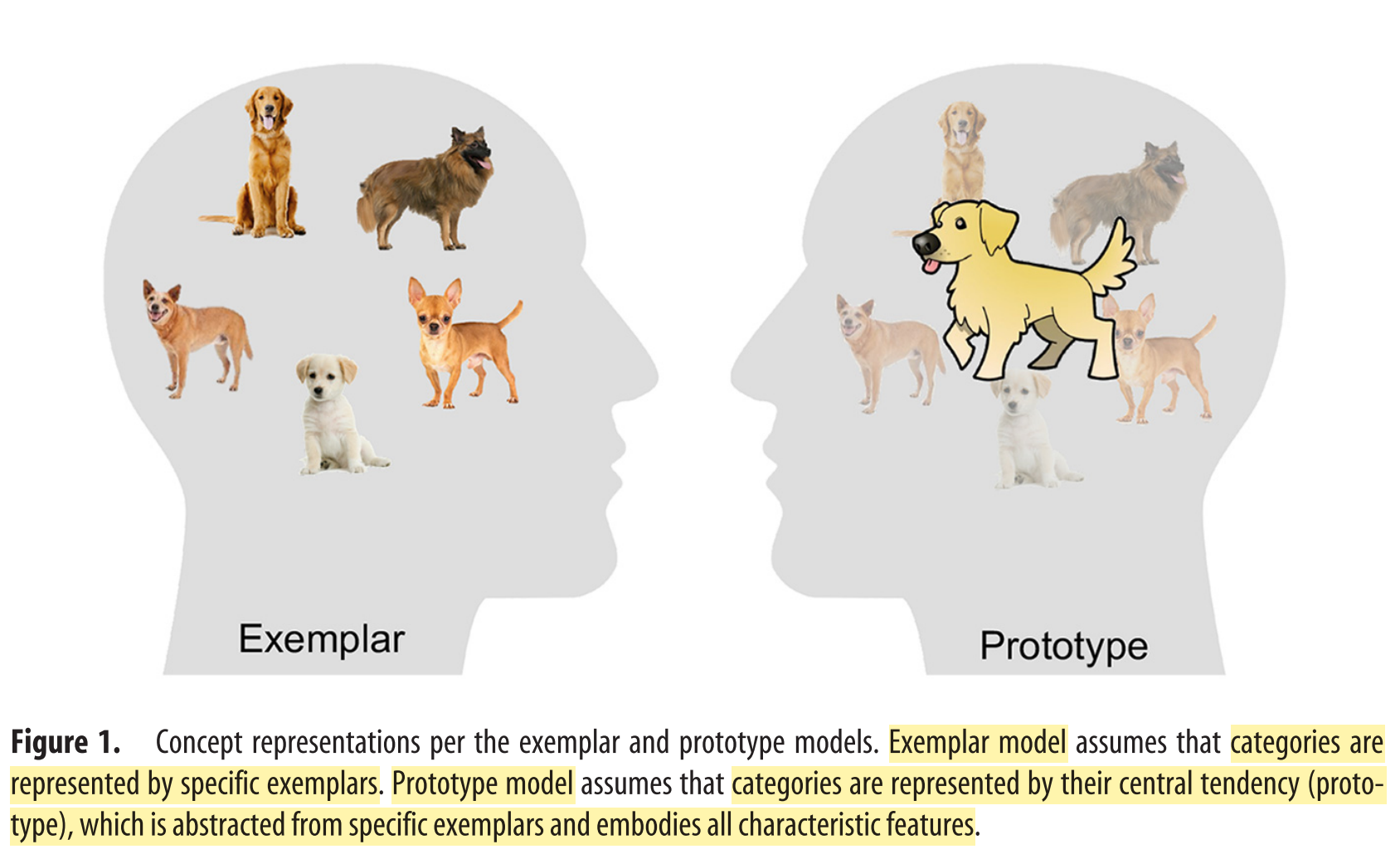
- RQ: What type(s) of memory representations are formed during concept learning and used in categorization decisions?
- Mack et al., 2013
- Goal: Test the degree to which brain signals are consistent with the exemplar model and the prototype model of categorization (脑信号在多大程度上与范例模型以及原型模型相一致).
- Result: There exists a network of regions representing specific exemplars during generalization judgements, but there is no evidence of generalized prototype representations.
- The tested categories have relatively low coherence, where some stimuli are equally distant from the central tendency of their category and that of the other category.
- Bowman and Zeithmova, 2018
- Goal: same as Mack et al., 2013
- Method: fMRI with a different category structure that includes greater coherence of stimuli within each category.
- Result: They found evidence consistent with the predictions of prototype model in both behavior and brain.
- Bowman and Zeithmova, 2019
- Hypothesis: Concept learning may involve both specific (exemplar) and generalized (prototype) representations under different conditions.
- Result: Coherence of the underlying category structure is a critical factor determining the success of forming a generalized category representation.
- Recent findings found that there exists distinct neural mechanisms for representing specific instances and for representing summary representations, with these mechanisms being differentially engaged for different category structures.
- Mack et al., 2013
- Bowman and Zeithmova, 2018
- Distinct neural mechanisms that create different types of memory representations may be engaged in concept learning, with their contribution varying across the category structure. Both specific and generalized memories may represent concepts and support generalization.
- Episodic inference (Underwood, 1949)
- When learning a set of overlapping associations, such as “A relates to B and B relates to C”, a relation is inferred between A and C (transitivity).
- Kumaran and McClelland, 2012
- Episodic inference can be achieved on-demand, from separate memories of individual events.
- Schlichting et al., 2014; Richter et al., 2016; Zeithamova and Preston, 2017
- Episodic inference can result from memory integration, where new events are linked with prior related memories into a combined representation.
- The same hippocampal-vmPFC interactions implicated in concept learning also implicate in memory integration and inference.
- The same regions underlie schema-related memory.
- Conclusion: Hippocampal-vmPFC memory integration mechanisms may serve to link related information to a coherent representation in service of concept learning.
Congruency (一致性) and reactivation aid memory integration
- Background: Congruency between associates and reactivation of previously learned information can facilitate memory integration.
- RQ1: How does the brain achieve such memory improvements?
- RQ2: How can memory integration processes be enhanced?
- van Kesteren et al., 2019
- RQ: How schema-congruency and active reactivation of existing knowledge improves memory and integration?
- Conclusions:
- Brain activity during memory integration is correlated with three behavioral factors: memory, congruency, and reactivation.
- Memory performance is associated with Medial Temporal Lobes (MTL), including the hippocampus.
- Congruency is associated with Ventromedial PFC (vmPFC) and hippocampus.
- Reactivation strength reveals an extensive retrieval network that includes vmPFC and hippocampus.
Integration of reward and concept representations in categorization
- Background: Reward is an important factor affecting categorization, but received little attention in neuroscientific studies of concept learning.
- Brain regions relevant to both reward and concept representation: vmPFC, intraparietal sulcus (IPS)/inferior parietal (IP).
- IPS/IP is active during categorization and is sensitive to category representation in humans and non-human primates.
- Braunlich and Seger, 2016
- RQ: How IPS/IP and vmPFC are involved in processing the sum of evidence for category membership and associated reward?
- Method: Present a task in which 4 features probabilistically related to category membership in series over time. Apply Bayesian model selection.
- Result: The interaction between evidence and time to the end of trial better accounts for activity than evidence alone in IPS/IP.
- Braunlich and Seger, unpublished observations
- RQ: How does reward availability affect evidence integration and decision during categorization?
- Results:
- Activity in IPS/IP increases as a function of the amount of evidence and time to reward.
- The vmPFC and anterior hippocampus show a ramping pattern of activity as time of reward approaches, indicating representation of both the sum of evidence and the temporal distance for reward availability.
- Hippocampus connectivity is associated with visual cortex.
- vmPFC is associated with both visual cortex and frontoparietal regions.
vmPFC may receive input from these regions that can be used to monitor the ongoing decision process and maximize reward.
- Recent complementary studies
- RQ: How reward expectation is integrated with representational knowledge during categorization?
- Braunlich et al., 2017
- Both IPS/IP and vmPFC are sensitive to distance in perceptual space from the stimulus to the current criterion.
- C.A. Seger, K. Braunlich, and Z. Liu, unpublished observations
- During stimulus presentation, IPS/IP is sensitive to the interaction of prototype distance and reward probability.
- IPS/IP is also sensitive to both reward and prototype distance prediction error at the time of feedback, indicating a possible role in updating representations based on feedback.
- The vmPFC is sensitive to reward probability at cue and feedback, indicating a role in maintaining contextual information about reward probability across the trial and integrating it with categorical information.
Modeling the role of the rostrolateral prefrontal cortex (前外侧前额叶皮层) in category learning and generalization
RQ: How are memory representations built around common information and retrieved on the basis of representational overlap to support novel judgements?
Nosofsky, 1986
- Similarity-based processes are critical for long-term category representation.
Smith and Sloman, 1994; Ashby et al., 1998
- In some cases, the similarity-based processes are supplemented by inferential processes that are akin to using logical rules or reasoning strategies.
Nosofsky et al., 1994; Palmeri and Nosofsky, 1995; Erickson and Kruschke, 1998; Juslin et al., 2001
- Rules may augment categorization during early statges of learning.
- Long-term representations are being formed and may be called upon again during generalization, when people are confronted with stimuli that are ambiguous or similar to multiple previously acquired category representations.
RQ: How are inferential categorization processes instantiated in the brain?
Christoff et al., 2001; Kroger et al., 2002; Bunge et al., 2005; Green et al., 2006; Hampshire et al., 2011; Watson and Chartterjee, 2012
- Abstract reasoning processes, such as higher-level reasoning, problem solving and analogy, depend on the rostrolateral PFC (rlPFC).
Daw et al., 2006
- rlPFC tends to be activated when people make the decision to explore new choice options rather than exploit options with the current highest expected value in reinforcement learning.
Desrochers et al., 2015, 2019
- rlPFC has interesting temporal trajectories across sequential tasks that do not vary temporally in their control demands per se.
Recent research in category learning hypothesize
- rlPFC instantiates an inferential process that is sensitive to the novelty and decisional uncertainty associated with a stimulus. Specifically, people will tend to engage rules when confronted with a stimulus that is both novel and difficult to categorize, given the previously learned category representations.
Paniukov and Davis, 2018
- rlPFC is engaged early in learning and remains engaged as long as the uncertainty about the correct category rule remains.
Davis et al., 2017
- rlPFC is more engaged during acquisition of relational category-learning rules than acquisition of feature-based category rules.
- Later, once the relational rules are well learned, the rlPFC is not activated anymore for relational rules. Instead, it is more activated to the extent that stimuli are novel examples of the previously learned relations.
O’Bryan et al., 2018
- rlPFC tracks the contribution of dissimilarity-based heuristics during generalization to novel ambiguous items.
- Such dissimilarity-based processes are based on high-level inferential strategies.
- rlPFC integrates decisional information and stimulus novelty to determine when to use inferential processes in category learning and generalization.
Different prefrontal cortex dynamics for learning at different levels of abstraction
Lateral PFC plays a central role for concepts when they require high levels of abstraction (Badre and D’Esposito, 2009) and rule-based reasoning (Davis et al., 2017; O’Bryan et al., 2018).
Lateral PFC also plays a role in low-level, similarity-based categorization (Davis et al., 2017; O’Bryan et al., 2018) and representation of specific exemplars (Mack et al., 2013).
Bowman and Zeithamova, 2018, 2019
- Distinct processes and types of representations can be involved in concept learning, with their relative contribution depending on the coherence among category members.
- Lower coherence (lower similarity among category members) makes the formation of generalized representations based on similarity difficult and may require a higher level of abstraction.
RQ: Are high-level abstractions simply use the same mechanisms and networks as low-level abstractions?
RQ: Do low- and high-level abstractions involve distinct anatomical circuits and functional mechanisms in the PFC?
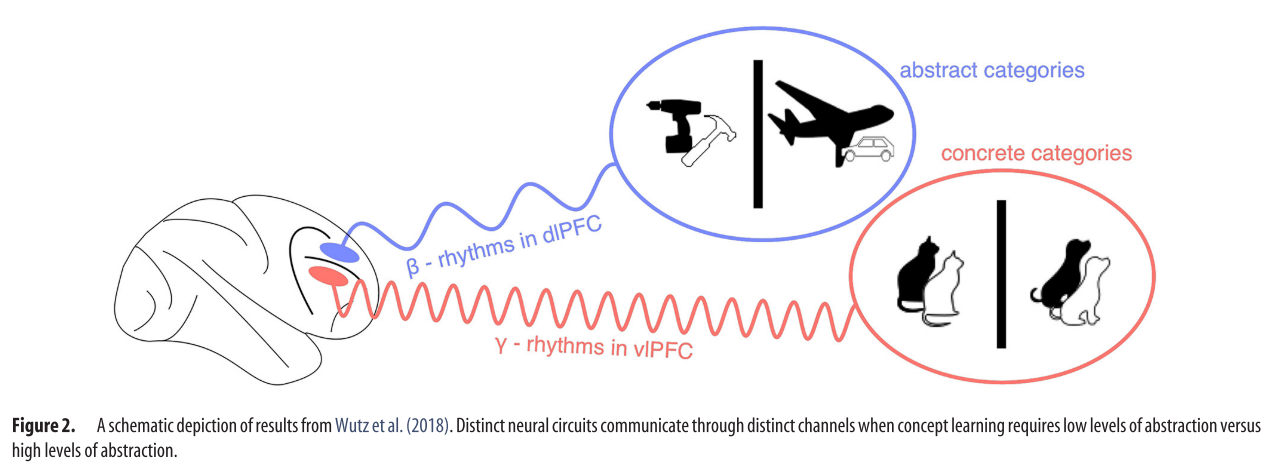
Wutz et al., 2018
RQ: How category abstractions is organized in prefrontal cortex?
Method:
- Record from multi-electrode arrays in lateral PFC and train monkeys in a dot-pattern category task (dot-pattern == exemplar).
- Control the level of abstraction for the category decision by varying the degree of spatial distortion of the exemplars from the prototype.
- Low-distortion exemplars look alike and can be categorized based on the similarity of their sensory features.
- High-distortion exemplars can look very different from each other, requiring greater abstraction.
Result: Monkeys generalized over a large pool of exemplars and eventually learned to extract the underlying category prototype.
Conclusion:
- Category abstraction is organized in different subregions in PFC.
- Ventrolateral PFC (vlPFC) is more engaged for low-level abstractions.
- Dorsolateral PFC (dlPFC) is more engaged for high-level abstractions.
Background: There exists distinct functional mechanisms based on different temporal dynamics and frequency characteristics (Buschman and Miller, 2007; Jensen et al., 2007; Engel and Fries, 2010).
- Gamma frequency oscillations are involved in bottom-up processing.
- Beta frequency oscillations are involved in top-down processing.
Results:
- Category signals for low-level abstractions in vlPFC are found in Gamma oscillations (60-160 Hz).
- Category signals for high-level abstractions in dlPFC are found in Beta oscillations (10-35 Hz).
Conclusions:
- Neurons in vlPFC are more driven by bottom-up inputs.
- Neurons in dlPFC are more driven by top-down inputs.
- Distinct neural circuits (vlPFC vs. dlPFC) communicate through distinct frequency channels (gamma vs. beta) and at different times (sample vs. delay epoch) when inferring regularities about the world on low- vs. high-levels of abstraction.

- Category processing through the vlPFC-gamma network may be viewed as an object recognition / pattern matching problem governed by bottom-up principles and subserving low-level abstraction.
- The dlPFC-beta network may implement top-down, experience-based generalization and identify more abstract, conceptual relationships that go beyond object recognition.
Future Research
- Investigate whether the lateral PFC is organized on the basis of representation type (rule vs. similarity-based) or if more general control mechanisms define its topography (e.g., gating or branching).
- Title: Brain Mechanisms of Concept Learning
- Author: Der Steppenwolf
- Created at : 2025-06-12 06:48:19
- Updated at : 2025-06-22 20:46:50
- Link: https://st143575.github.io/steppenwolf.github.io/2025/06/12/Brain-Mechanisms-of-Concept-Learning/
- License: This work is licensed under CC BY-NC-SA 4.0.